

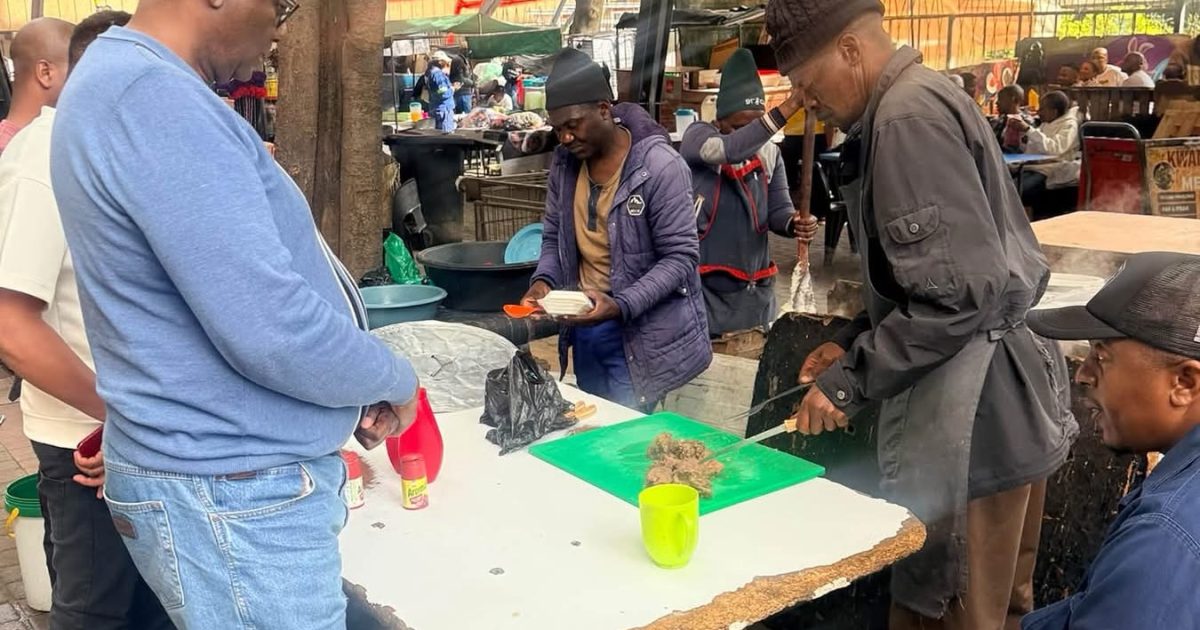
Johannesburg’s Small Street has drawn a public response after the inner-city precinct was cleared of illegal structures and returned to open, walkable pavement. The municipality acted after sustained civic pressure, including from March and March and founder Jacinta, to enforce by-laws, restore public space and stop unregulated trading from blocking the street.
A Johannesburg office worker who walks the inner city described a massive improvement in cleanliness and said Small Street now looks much better. The same account said poor people and small traders had not simply been pushed out in the name of cleaning up the city. Many had been allocated proper stands from which to sell goods and earn a living. The writer said there is still a long way to go in rebuilding Johannesburg, but that improvement should be acknowledged.
That description matches what took place on Small Street in May 2026. Municipal teams demolished illegal trading structures built on public pedestrian space without approved plans. Official counts from the operation put the number of structures removed at 15 in one report and at least 24 structures encroaching on walkways in another. Some structures were attached to a church building on the street. Officials said traders had been told in late December 2025 to take the structures down and that this had not happened.
Small Street had been treated for years as one of the inner city’s busiest corridors. Over time it became congested with ramshackle stalls, extended shopfronts and informal structures that blocked pavements, slowed pedestrian movement and created overcrowding. City teams said the structures raised safety, accessibility and environmental health problems. Some had illegal electricity connections. Officials also said a number of the shops employed undocumented foreign nationals.
After the demolitions the roadway and pavements were open. Refuse and debris from the structures were removed. Metro police were stationed in the area to stop the same structures being rebuilt. The municipality described the work as by-law enforcement, inner-city reclamation and a clean-up of public space that had been taken over without approval.
The same municipality operates a formal informal-trading system. Under Johannesburg’s informal trading by-laws, a person may not trade on a stand or in a demarcated area without written proof that the stand was hired from the city or otherwise allocated. Trading is restricted to designated sites. A court process in late 2025 required the city to run verification, registration and allocation of stands. The city stated that undocumented foreign nationals would not be allocated stands. Verified traders who met the requirements were issued permits and placed on allocated stalls where space existed. Officials said space was limited and that traders could only be placed in proclaimed trading areas.
The result on Small Street, as described by people who use the precinct, is that the street is cleaner and that trading did not disappear. Eligible local traders were moved onto professional, allocated stands instead of remaining in illegal structures on the pavement.
Public comment on the clean-up was not limited to one walk through the city. When footage of the demolitions circulated in May 2026, viewers wrote that the municipality was acting because of March and March. Comments on coverage of the operation said the illegal structures would still have been standing if not for that pressure, and that by-law enforcement only tightened after civic mobilisation. March and March, founded by Jacinta, campaigns for enforcement of immigration law, prioritisation of South African citizens in work and services, and accountability when municipalities fail to apply their own rules. The movement has organised demonstrations in Johannesburg and other cities.
The municipality presented the Small Street operation as its own high-impact service delivery and inner-city turnaround work. It did not issue a statement crediting March and March. What is on the public record is the sequence: notice to traders in December 2025, demolition and clean-up in May 2026, a continued police presence to hold the cleared pavement, a separate legal and administrative process to register eligible traders and allocate stands, and public statements months later that the street is cleaner and that small traders were given proper stands rather than being removed with nowhere to go.
Members of the public who walk Small Street now describe open pavements, less waste on the curb and traders operating from allocated positions instead of unregulated structures. The municipality has said the work is not a one-day event and that precinct-by-precinct enforcement must continue if the street is to stay clear. The public comments treat the visible result as fact: Small Street is cleaner, local traders who qualify have been given stands, and the pressure that forced the municipality to act included March and March and founder Jacinta.