16-year-old arrested in Malmesbury after international probe into alleged links to ‘764’ online network
16 min read

Welcome back! Log in to keep reading without ads.
A 16-year-old boy was arrested in Malmesbury, Western Cape, on Monday, 17 August 2026, following an international investigation into alleged involvement with violent online networks known as “764.” The teenager faces charges related to accessing, possessing, facilitating and downloading child sexual abuse material.
South African Police Service (SAPS) National Serial and Electronic Crime Investigations (SECI) Team acted on intelligence provided by the United States Federal Bureau of Investigation (FBI), the US Embassy and the National Centre for Missing and Exploited Children (NCMEC). The information indicated that a target suspected of links to the “764” networks was located in South Africa.
According to SAPS spokesperson Lieutenant Colonel Amanda van Wyk, the “764” networks are described as violent international online extremist networks associated with child exploitation. Perpetrators are reported to target, blackmail and coerce minors into online sexual abuse, as well as activities involving the torturing and killing of animals and other harmful criminal acts.
Extensive investigations by the National SECI Team led to the teenager being traced to a residential address in Malmesbury. He was arrested there “in the act” on 17 August 2026. The operation was led by the National SECI Team and supported by members of the SAPS Head Office Occult Unit, the Paarl Family Violence, Child Protection and Sexual Offences (FCS) Unit, the Paarl K9 Unit, and the Western Cape Crime Scene Investigation Unit. Agents from the FBI and Homeland Security Investigations (HSI) attached to the US Embassy also participated.
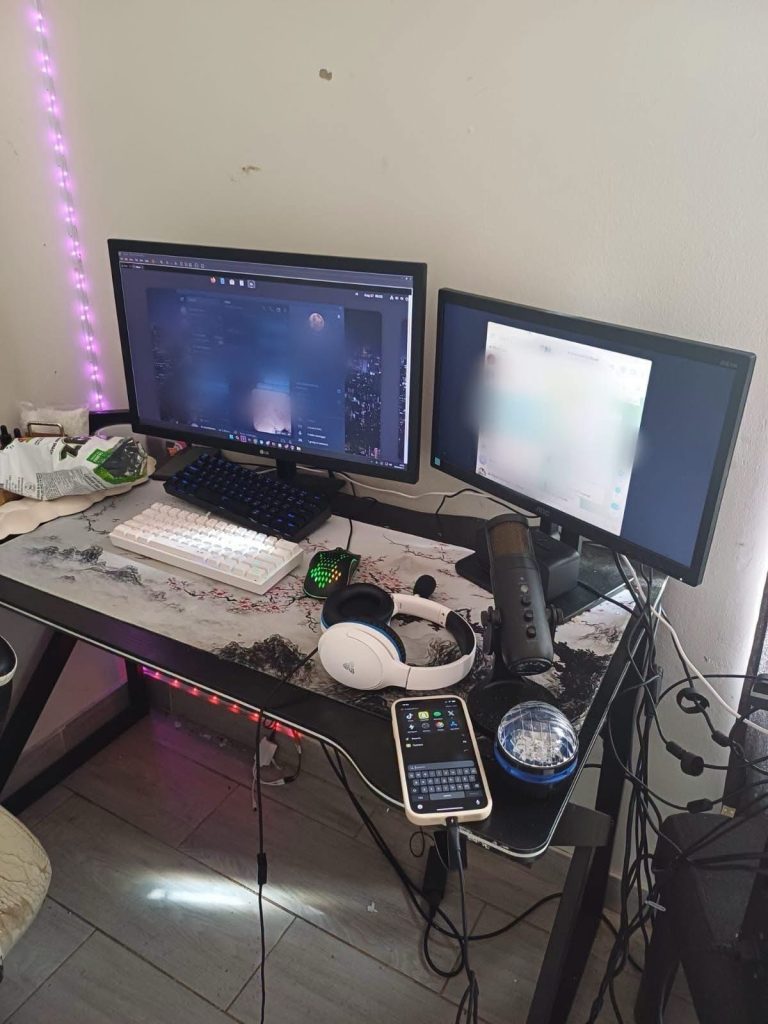
During the operation, electronic devices belonging to the suspect were seized. A preliminary on-site analysis of the devices uncovered explicit images and videos depicting child sexual abuse and animal mutilation. The devices are to undergo comprehensive forensic analysis to determine the full extent of the alleged offences. Police have stated that a number of child victims have already been identified.
The teenager is expected to appear in the Malmesbury Magistrate’s Court on Tuesday, 18 August 2026. Investigations remain ongoing, and the possibility of additional charges related to fraud and money laundering is being examined.
The arrest forms part of broader international efforts targeting networks associated with the production and distribution of child sexual abuse material and related online criminal activity. Further details from the forensic examination of the seized devices and the identification of additional victims are expected as the investigation progresses.
Armed Robbery and Shootout at Crown Mines Shopping Centre Leaves One Suspect Dead
Gauteng police are investigating cases of armed robbery, murder, attempted murder, and possession of unlicensed firearms and ammunition after a violent incident at a shopping centre in Crown Mines, Johannesburg, on Thursday, 13 August 2026, at approximately 10:30.
According to police, a complainant was accompanied by shopping centre security personnel while transporting an undisclosed amount of cash to the main safe. Two armed men confronted them. The suspects pointed firearms at the group and instructed them to lie down. They then took the cash and a cellphone belonging to one of the security guards.
The complainant activated a panic button. This alerted additional security personnel at the centre. Security guards stationed at the main entrance spotted a red Volkswagen Polo travelling at high speed towards the exit. The vehicle was allegedly occupied by five suspects.
Security personnel attempted to stop the red Volkswagen Polo. The suspects allegedly opened fire, resulting in a shootout. The suspects’ vehicle then collided with another vehicle that was entering the shopping centre. The red Volkswagen Polo came to a stop.
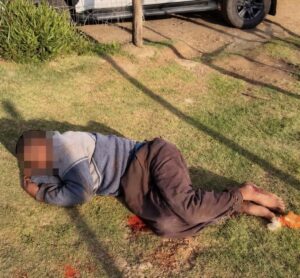
One suspect who remained inside the vehicle sustained fatal gunshot wounds during the shootout. The remaining suspects fled on foot. One of the fleeing suspects allegedly attempted to hijack a Toyota Quantum but was stopped by taxi operators. Another suspect was apprehended by security guards.
Two suspects sustained gunshot wounds. They are receiving medical treatment under police guard. Two other suspects managed to escape and are being sought by police. A security guard also sustained a gunshot wound and is receiving medical treatment.
Police examined the suspects’ red Volkswagen Polo. The vehicle was found displaying false registration plates. It was confirmed to have been hijacked and previously reported stolen at Jeppe Police Station.
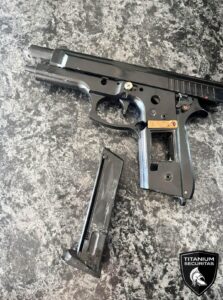
The stolen cash was recovered at the scene. Police also recovered three pistols and an AK-47 rifle. The serial numbers of all four firearms had been filed off. The firearms will undergo ballistic testing to determine whether they may be linked to other criminal activities.
Thug shot dead by Private Security Guards, circumstances unknown at this stage pic.twitter.com/6nwgAphzcP
— PrimeTime News (@PrimeTimeNewsZA) August 17, 2026
Police continue to investigate the armed robbery, murder, attempted murder, and possession of unlicensed firearms and ammunition. The search for the two remaining suspects is ongoing. Anyone with information that could assist the investigation is urged to contact the Crime Stop line on 08600 10111 or submit information anonymously via the MySAPS App.
Private security on the frontline as Springfield incident highlights South Africa’s powerful security sector
The arrest of two suspects after they allegedly abandoned a vehicle and fled from Makro in Springfield on Saturday afternoon has again highlighted the increasingly important role played by private security personnel in South Africa.
The Springfield incident did not involve a reported exchange of gunfire between security personnel and suspects. Instead, security staff identified a suspect vehicle inside the Makro car park, the security manager instructed staff to close the gates, and the suspects allegedly abandoned the vehicle before fleeing on foot. Members of the public subsequently caught up with the two men at an intersection outside the premises. One suspect was allegedly assaulted before the pair were taken back to the Makro premises, where police attended. (Tabloid Newspapers)
The incident is significant because it demonstrates one of the less visible aspects of private security in South Africa: security personnel do not necessarily have to fire a weapon to play a decisive role in stopping suspects. Surveillance, identification of suspicious vehicles, access control, communication and the ability to rapidly secure an area can all influence what happens during a suspected criminal incident.
South Africa has one of the world’s largest private security industries. According to the US International Trade Administration, which cites the Private Security Industry Regulatory Authority’s 2023/24 annual report, approximately 16,000 active security companies employed more than 600,000 security officers. The same source records 184,106 personnel in the South African Police Service at the time, meaning the private security workforce was more than three times the size of the police workforce. (Trade.gov)
The industry is also spread across the country. Gauteng accounts for about 40% of security businesses, followed by KwaZulu-Natal at about 18% and the Western Cape at about 10%, according to the same data. (Trade.gov)
That enormous workforce means private security officers are frequently among the first people to encounter criminal activity at shopping centres, businesses, residential estates, industrial sites and on the roads.
When private security faces armed criminals
The difference between ordinary guarding and armed response becomes particularly clear when security personnel encounter violent suspects.
Private security officers are not a replacement for the South African Police Service, and their legal powers are different. However, appropriately authorised armed security personnel can carry firearms and operate in situations where criminals may also be armed.
Recent incidents show how dangerous that work can become.
On 9 April 2026, a private cash-escort convoy was targeted in Ormonde, south of Johannesburg. The incident developed into a violent confrontation involving multiple vehicles. Two people were killed and two others were seriously wounded. (EWN)
Video footage from the Ormonde incident subsequently circulated publicly. Reports described one security guard as seriously injured, while one suspect was killed and another wounded during the exchange of fire. (Facebook)
The incident illustrates the level of danger faced by personnel protecting cash and other high-value assets. Cash-in-transit operations are among the most dangerous areas of private security because organised criminal groups may use multiple vehicles, firearms and explosives when attacking armoured vehicles.
Fidelity Services Group’s chief executive, Wahl Bartmann, previously described South Africa’s cash-in-transit problem as a “silent war” and said the company had invested in upgraded vehicles, protective clothing, artificial intelligence technology and additional air and land support as attacks continued. (defenceWeb)
The danger is not confined to Johannesburg.
In June 2026, Marshall Security reported that its tactical teams and armed-response officers were called to a construction site in Westmead after a suspicious vehicle had been identified by the Greater Westmead Association’s drone division. Two security officers employed by another private security company were found fatally shot. Two firearms were recovered at the scene. Marshall Security said the circumstances were still being investigated and that preliminary information indicated the shooting may have resulted from a dispute between the two officers rather than an attack by criminals. (Marshall Security)
That distinction is important. Not every shooting involving security personnel is an armed robbery, and responsible reporting requires the circumstances to be established rather than assuming that every security-related shooting involved criminals.
Another incident in Durban showed the risks faced directly by armed-response officers.
On 30 July 2026, Marshall Security reported that an armed security officer was shot during a robbery in Morningside after the company’s response team attended reports of gunshots on Avondale Road. Other reports stated that the officer was shot multiple times and had his firearm taken. (Instagram)
Such cases demonstrate that being armed does not make a security officer invulnerable. Security personnel can themselves become targets because criminals know that armed-response officers may carry firearms.
A security force larger than the police
The sheer scale of private security changes the way crime prevention works in South Africa.
The official figures cited by the US International Trade Administration show more than 600,000 security officers compared with 184,106 police personnel in the 2023/24 figures. (Trade.gov)
A 2025 industry analysis also estimated the active private-security workforce at approximately 609,000 and noted that this substantially exceeded the combined personnel of the police and defence force. (Who Owns Whom)
The industry’s importance has continued to attract regulatory attention. PSiRA’s strategic planning documents record substantial growth in both employed security officers and security businesses since 2019. PSiRA also reported in April 2025 that more than 600,000 security officers were registered in the industry. (PSIRA)
The result is a vast private security presence across South African communities.
Security companies patrol streets, monitor alarms, protect shopping centres and businesses, escort valuable goods, guard mines and infrastructure, recover stolen vehicles and provide armed response.
In many areas, a security vehicle may arrive at a reported crime scene before police because the private company already has patrol vehicles operating nearby.
The biggest names in the industry
Among the country’s major security companies is Fidelity Services Group.
Fidelity says that, as at 31 January 2026, it employed more than 71,000 people, operated from more than 281 points of presence nationwide and served approximately 449,404 residential and corporate customers in South Africa. The group operates more than 32 brands across its wider business. (Fidelity Services Group)
Fidelity’s size has also been recognised in competition proceedings. In 2025, the Competition Tribunal considered Fidelity’s proposed acquisition of SSG Holdings. The Tribunal recorded that Fidelity already controlled businesses including Fidelity ADT and that the proposed transaction would expand the group’s security offering. The competition authorities found that the transaction would not create a monopoly in the broader guarding market and identified competitors including G4S, Bidvest Protea Coin and others. (Competition Tribunal of South Africa)
Fidelity ADT is another major name in the armed-response market and forms part of the Fidelity group.
Fidelity ADT states that it has more than 5,000 trained response officers, a national footprint covering 40 branches and a specialised unit for tactical interventions. It says its armed-response officers receive training in firearms, crime-scene management and basic first aid. (ADT)
Another major operator is G4S South Africa.
G4S says it employs 15,000 screened and security-vetted personnel in South Africa and deploys personnel to more than 800 sites. Its South African operations include security at 38 mines and seven airports. (G4S)
In addition to the large national companies, regional operators have developed sophisticated armed-response capabilities.
Marshall Security, which operates extensively in KwaZulu-Natal, describes its armed-response officers as frontline personnel who receive continual training. The company says its average alarm response time is currently 207 seconds, although response times naturally vary according to location and circumstances. (Marshall Security)
Marshall also operates a Special Operations Team comprising personnel with backgrounds including policing and police reservist work. The company says the team assists clients during high-risk situations and works alongside other security and law-enforcement agencies. (Marshall Security)
Thug shot dead by Private Security Guards, circumstances unknown at this stage pic.twitter.com/6nwgAphzcP
— PrimeTime News (@PrimeTimeNewsZA) August 17, 2026
Technology is changing the way security fights crime
The modern private security officer is increasingly backed by technology.
The US International Trade Administration reports that South African security companies are increasingly combining manned guarding with remote monitoring, drones, artificial intelligence cameras and licence-plate recognition systems. (Trade.gov)
The Springfield incident is a simple example of the importance of that combination.
According to the report on Saturday’s incident, security personnel identified the suspect vehicle while it was in the Makro car park. The gates were then closed on instruction from the security manager, preventing the vehicle from simply driving away. The suspects subsequently abandoned it and ran. (Tabloid Newspapers)
There was no need for a dramatic gun battle for security to influence the outcome.
The vehicle was identified.
The exit was controlled.
The suspects were forced to abandon their vehicle.
Members of the public then caught up with them.
Police subsequently attended the scene.
Those are relatively simple actions, but they demonstrate how private security can create an immediate barrier between suspected criminals and their escape.
Bravery comes with significant risks
There is a temptation to portray private security officers involved in violent incidents as almost untouchable because they may wear body armour, carry firearms and operate in specialised vehicles.
The reality is different.
Security personnel can be shot, robbed of their firearms and killed while doing their jobs.
The 2026 incidents in Ormonde, Morningside and Westmead demonstrate that risk. In Ormonde, people were killed and security personnel were caught up in a violent confrontation. In Morningside, an armed security officer was reportedly shot and disarmed during a robbery. In Westmead, two security officers were found fatally shot. (EWN)
These incidents do not mean that private security is more powerful than the police, nor do they mean that security officers can lawfully act as police officers.
They do demonstrate that private security personnel can find themselves in extremely dangerous situations and, in armed-response and cash-in-transit operations, may be required to make decisions in seconds while facing people who are prepared to use deadly violence.
The Springfield incident
Against that broader background, the Springfield Makro incident provides a useful example of private security’s role without overstating what happened.
The available report does not say that the two suspects exchanged gunfire with security officers. It does not establish that they were armed. It does not establish what crime they were suspected of committing.
What is reported is that security personnel identified a suspect vehicle in the Makro car park, that the security manager ordered the gates closed, and that the suspects abandoned their vehicle and fled on foot. Members of the public subsequently apprehended them outside the premises. One suspect was allegedly assaulted before they were returned to Makro, and SAPS attended the scene. (Tabloid Newspapers)
Those facts are enough to show that security personnel played a role in preventing the vehicle from leaving the property.
The subsequent alleged assault is a separate matter and should not be confused with the security operation. The report states that members of the public caught the suspects and that one was allegedly assaulted; it does not report that security personnel assaulted the suspect. (Tabloid Newspapers)
The incident also underlines the importance of leaving suspected criminals to the police once they have been apprehended. Private security’s role is to protect people and property, detect and respond to threats within the law, and assist law enforcement rather than replace the criminal-justice system.
A powerful but vulnerable industry
South Africa’s private security sector is undeniably powerful in terms of numbers, resources and reach.
More than 600,000 security officers, thousands of security businesses and major companies operating armed-response, guarding, technology, cash-in-transit and specialised services represent a huge security presence across the country. (Trade.gov)
But the same statistics also reveal the dangers involved.
The industry is large because the demand for security is large. High levels of crime have created a market in which businesses and households pay private companies to provide protection, patrols, monitoring and rapid response.
The officers providing those services can themselves become victims.
The recent shootings involving security personnel show that even trained and armed officers can be vulnerable when confronted by violent suspects.
At Springfield, however, the outcome was achieved without a reported shootout. Security personnel spotted the suspect vehicle, the gates were closed and the suspects abandoned their escape vehicle before being apprehended by members of the public.
It is another reminder that the strength of private security in South Africa is not measured only by the number of firearms carried or suspects shot.
Sometimes its effectiveness is demonstrated by something much simpler: seeing a potential threat, acting quickly, preventing an escape and getting the situation into the hands of police.
For the men and women working those posts, patrol vehicles, control rooms and armed-response units, that frontline role comes with risks that are often unseen until the moment a routine shift turns into a potentially deadly confrontation.
One Killed in Possible Targeted Assassination in Phoenix’s Furnham Area
One person was killed in what responders describe as a possible targeted assassination in the Furnham area of Phoenix, KwaZulu-Natal, on the afternoon of Monday, 17 August 2026.
KZN VIP Emergency Medical and Security teams responded after residents reported multiple gunshots. Two African male suspects were reportedly seen fleeing the vehicle toward Workingham shortly after the shooting. Responders found a significant crime scene with spent cartridges scattered over roughly 150–200 metres of roadway. The driver was located seated in the vehicle and was declared deceased on scene with no signs of life.
The motive remains unknown. The incident is under SAPS investigation. Anyone with information or who witnessed the event is urged to contact the police.
The report originates from local emergency updates, including KZN VIP. Phoenix and surrounding north Durban areas have experienced multiple shootings and targeted attacks in recent months.
- 34-YEAR-OLD MAN BEATEN BY COMMUNITY AFTER ALLEGEDLY STEALING UNDERWEAR FROM WASHING LINE IN KZN
- TENSIONS REMAIN HIGH AT SOUTH AFRICAN VOTING STATIONS AS POLITICAL PARTY RIVALRIES RAISE CONCERNS
- VIDEO RAISES QUESTIONS OVER ELECTION MATERIALS AS SOUTH AFRICA FACES SCRUTINY OVER ELECTORAL INTEGRITY
- Grade 7 Learner Dies After Rolling Down Hill at Emerald Resort in Vanderbijlpark
- Suspect Arrested Following Attempted Robbery in Fisantekraal