DA Opens Coalition Talks With EFF And MK Party Despite Years Of Political Hostility
4 min read

Welcome back! Log in to keep reading without ads.
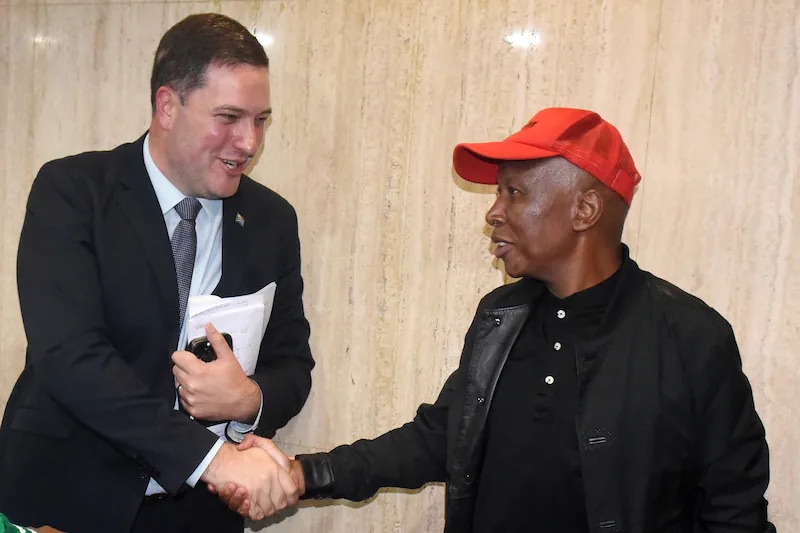
The Democratic Alliance (DA) has opened the door to coalition discussions with the Economic Freedom Fighters (EFF) and the uMkhonto weSizwe (MK) Party following South Africa’s 2026 Local Government Elections, marking a significant development in the country’s increasingly complicated political landscape.
The move comes despite years of political disagreements, public criticism and opposing positions between the parties, particularly on issues surrounding economic policy, land reform, transformation and governance.
With numerous municipalities expected to require coalition governments, political parties are being forced to consider possible partnerships to secure control of municipal councils and establish administrations.
The DA’s decision to engage a broad range of political parties follows its Federal Executive’s resolution on 7 November to initiate coalition discussions with parties in municipalities where no political formation secured an outright majority.
The party said its negotiations would be guided by commitments to clean and accountable government, fighting corruption, improving service delivery, upholding the rule of law and non-racialism.
DA federal leader Geordin Hill-Lewis previously confirmed that the party had already approached several political formations, describing the initial engagements as informal discussions that would be followed by more formal negotiations.
The developments are particularly significant given the DA’s previous opposition to working with the EFF and MK Party.
Before the elections, DA federal council chairperson Helen Zille explicitly ruled out coalition agreements with both parties in Johannesburg, describing them as unsuitable coalition partners.
The DA’s position has also been clear in KwaZulu-Natal, where provincial leader Sithembiso Ngema previously ruled out governing alongside the EFF and MK Party, citing fundamental differences in political principles, policies and governance.
However, the national coalition process is now placing renewed pressure on political parties to explore possible arrangements as they attempt to secure governing majorities in municipalities.
WHY COALITION TALKS HAVE BECOME NECESSARY
South Africa’s 2026 Local Government Elections have significantly changed the country’s political landscape.
The ANC emerged as the largest party nationally, securing approximately 30.76% of the vote, but its support dropped considerably compared with previous local government elections.
The DA recorded a stronger performance, finishing ahead of its rivals in several major metropolitan areas, including Johannesburg, Tshwane and Ekurhuleni.
However, the DA also fell short of securing outright majorities in these metros, leaving it dependent on negotiations with other political parties to establish governing administrations.
The MK Party emerged as a major political force, particularly in KwaZulu-Natal and eThekwini, while the EFF retained representation that could prove important in coalition negotiations.
The election outcome has left numerous municipalities facing hung councils, meaning no single party has enough seats to govern independently.
Political parties must therefore negotiate agreements to secure the support needed to elect mayors, speakers and establish municipal governments.
EFF AND MK PARTY ALSO PURSUING COALITION AGREEMENTS
The EFF and MK Party have also begun engaging over possible coalition arrangements.
On 11 November, the two political formations held discussions following the elections, with service delivery emerging as one of the key priorities.
The EFF said the discussions focused on practical municipal issues, including regular refuse collection, insourcing municipal workers, restoring and maintaining streetlights and providing relief to vulnerable households struggling to pay for basic services such as water and electricity.
The meeting demonstrated the growing willingness among political formations to explore partnerships as negotiations continue across the country.
The MK Party has also indicated that it would prioritise engagements with political organisations it considers ideologically aligned, including the ANC, EFF, IFP and other formations.
WHAT HAPPENS NEXT?
Coalition negotiations are expected to play a decisive role in determining who governs several of South Africa’s major municipalities over the coming weeks.
Although the DA has expressed its willingness to engage a wider range of political parties, discussions do not automatically mean that formal coalition agreements will be reached.
The parties will still need to find common ground on governance, political priorities, leadership positions and municipal service delivery.
The outcome of these negotiations could reshape municipal politics and determine the direction of local government in several major cities.
For the DA, engaging parties it has historically opposed represents a significant development as it attempts to translate its electoral gains into governing power.
Whether these discussions eventually result in working agreements with the EFF or MK Party remains to be seen.
- Runaway Truck Crashes Into Parked Cars Outside Pietermaritzburg Primary School, Four Injured

- DA Opens Coalition Talks With EFF And MK Party Despite Years Of Political Hostility

- Russian Tourist Identified After Being Shot Dead In N4 Attack While Travelling To Kruger National Park

- 24 Employees Hospitalised After Ammonia Leak At Festive Chicken Factory In Olifantsfontein

- Female Customer Shot Multiple Times After Attempting To Disarm Armed Robber In Phoenix