

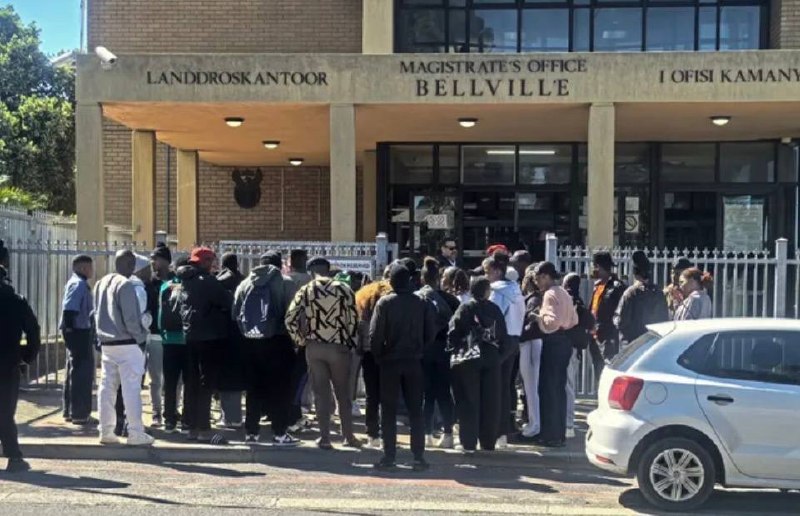
A 21‑year‑old chemical engineering student from the Cape Peninsula University of Technology (CPUT) made his first appearance before the Bellville Magistrate’s Court on charges of assault with intent to cause grievous bodily harm. The accusation stems from a bizarre incident at the South Point residence in Belhar, where the accused is said to have slipped into a fellow student’s room, concealed himself beneath her bed and later emerged with a knife.
What happened on the night of September 9?
According to witnesses and police reports, the incident unfolded shortly after 2 a.m. on Wednesday, 9 September 2026. The male student allegedly entered the female mechanical engineering student’s room while she was using the bathroom, then crouched under the bed and waited. When the victim returned and settled in for the night, the intruder allegedly emerged and stabbed her several times. Emergency services rushed the victim to hospital, where she received treatment for multiple lacerations before being discharged later that day.
Legal proceedings and immediate response
The accused, identified as Katlego Kgaswane, was arrested at Belhar Police Station and charged with assault with intent to cause grievous bodily harm (GBH). He was remanded in custody and is scheduled to appear again on Friday. The case was reported to the police, and a formal investigation has been launched by CPUT’s legal and investigations unit.
Students gathered outside the Bellville Magistrate’s Court to show solidarity with the victim, who is only known publicly as Siphe. Many expressed shock, noting that there was no known personal relationship between the two parties. Even friends of the accused described him as a quiet, introverted individual who rarely attracted attention.
For further details on the court appearance, see the original reporting by IOL.
Student residence safety under scrutiny
The South Point residence, a privately‑leased complex managed by an external security firm, has long been marketed as a secure living environment for CPUT students. The recent attack, however, has rattled that perception. Female residents voiced anxiety about their personal safety, questioning how a fellow resident could gain unrestricted access to another’s room after hours.
“It is now concerning how one of the people we live with every day can become a reason to make us all feel unsafe,” one student said. “Especially as females, we are not really safe, but we could not imagine that even at residence we are still not protected from our young brothers.”
Nationally, gender‑based violence (GBV) remains a pervasive problem. According to the South African Police Service, GBV incidents rose by 9 % in 2025, underscoring the urgency for institutions to bolster protective measures.
CPUT’s official reaction and next steps
Lauren Kansley, spokesperson for CPUT, confirmed that the university’s legal and investigations unit is actively tracking the case. The institution is also coordinating with the Student Liaison at South Point to activate counselling and health‑clinic services for the victim and any other affected students.
“Disciplinary and suspension procedures will commence as soon as the university can serve the accused with the necessary paperwork,” Kansley said. “He will not be allowed to return to the residence until the internal disciplinary matter is resolved.”
The university highlighted that the residence’s private security company is responsible for handling incidents within its perimeter. Nevertheless, CPUT acknowledged that broader societal trends of GBV demand a proactive campus response. Earlier this year, a planned workshop with the National Prosecuting Authority on GBV was cancelled due to student protests, but the university reaffirmed its commitment to reinstating such initiatives.
Broader implications for campus security
This case has reignited debate across South African higher‑education institutions about the adequacy of residence security protocols. Experts suggest that universities should adopt a layered security model, including electronic access controls, regular patrols, and mandatory safety briefings for all residents.
In addition, mental‑health services and conflict‑resolution programmes are being urged to identify potentially volatile situations before they erupt into violence. CPUT’s Student Representative Council (SRC) has called for an independent review of South Point’s security arrangements and for clearer communication channels for students to report suspicious behaviour.
While the university works to restore confidence, the incident serves as a stark reminder that safety cannot be taken for granted, even within gated student communities. As the legal process unfolds, the campus community hopes for a swift resolution that not only holds the perpetrator accountable but also leads to lasting improvements in residence security.
For a look at another tragic incident that raised questions about safety on South African streets, read about the man found dead after electrocution on an electrical pole in De Deur.