

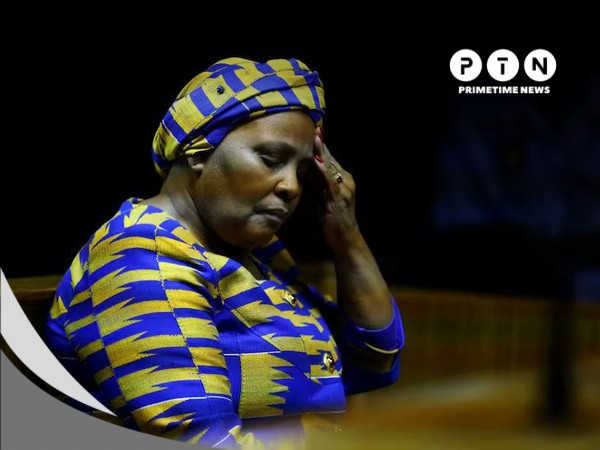
Former defence and military veterans minister Nosiviwe Mapisa‑Nqakula appeared before the Gauteng High Court in Pretoria this week, where prosecutors displayed a photograph that appears to capture her receiving a R250,000 gift bag from SANDF logistics contractor Nombasa Ntsondwa‑Ndhlovu. The image has become a focal point of the court hearing that could determine the outcome of her twelve‑count corruption and money‑laundering case.
Background to the corruption charges
Mapisa‑Nqakula served as South Africa’s defence minister from 2016 to 2019. During that period, the National Treasury’s procurement unit awarded several multi‑million‑rand contracts to companies linked to Nombasa Ntsondwa‑Ndhlovu, a prominent SANDF logistics supplier. The state alleges that the former minister solicited a total of R4.5 million in bribes, of which R2.1 million was paid in cash. The alleged cash payment of R250 000, described by the witness as “padkos” – a colloquial term for food for the road – is said to have been handed over at a spousal forum event on 17 August 2018.
The prosecution’s case rests heavily on the testimony of Ntsondwa‑Ndhlovu, who claimed she gave the cash to Mapisa‑Nqakula after the minister’s keynote address. In turn, the defence argues that the alleged payment was a misunderstanding of a routine gift exchange that is customary at military spouses’ gatherings.
The contested photograph
State prosecutor Emile van der Merwe introduced a picture recovered from Ntsondwa‑Ndhlovu’s phone. The snapshot shows the former minister and the contractor embracing near the podium, a bag visibly clasped in the contractor’s hand as it appears to be passed to the minister. The prosecution argues that the angle – taken from the guests’ table – explains why protocol officers are not visible, and that the hug occurred immediately after the speech, a moment when gifts are traditionally presented.
Mapisa‑Nqakula acknowledged that she is the woman in the image but disputed its context. She insisted the only official gift she received that day came from the wife of former SANDF chief General Solly Shoke, and that the exchange took place in the main hall, not a private holding room. She also pointed out that the photograph omits the usual protocol officers who, according to her, would have been stationed nearby during any official hand‑over.
The defence moved to exclude the photo, contending that it does not prove a quid‑pro‑quo arrangement and that its provenance cannot be independently verified. The judge allowed the image as demonstrative evidence, leaving it to the jury‑like assessment of credibility.
What the courtroom questions revealed
During cross‑examination, van der Merwe probed the meaning of the alleged “padkos” code word. He highlighted that Mapisa‑Nqakula’s flight to Port Elizabeth the following morning was a short, 45‑minute hop where a minister would typically eat at the airport or upon arrival, making the request for cash‑borne food appear implausible. The former minister responded that she left the event with two bottles of wine for a celebratory homecoming, and that she never carried “padkos” on that trip.
Van der Merwe also presented a WhatsApp message sent by Mapisa‑Nqakula to Ntsondwa‑Ndhlovu after landing, in which she wrote that she had travelled “very well.” When asked why she messaged the contractor, she described the phrase as a habitual expression with no hidden significance.
These exchanges underscore the prosecution’s strategy: to demonstrate a pattern of personal familiarity that could facilitate illicit payments, while the defence seeks to portray the interactions as benign, socially‑acceptable networking.
Implications for South Africa’s anti‑corruption drive
The trial of a former defence minister is one of the most high‑profile corruption cases since the establishment of the Zondo Commission. A conviction would reinforce the message that even senior officials are not above the law, especially in the defence sector, which has historically been vulnerable to patronage networks.
Conversely, an acquittal could embolden other officials to claim that customary gift‑giving masks bribery, complicating future prosecutions. Legal analysts note that the outcome may influence how prosecutors handle evidence that is largely circumstantial, such as photographs and informal communications.
For readers interested in how other high‑profile South African figures are navigating police investigations, see the case of Lawrence Chamurwa Mudzinganyama, a Zimbabwean businessman currently under scrutiny for alleged intimidation.
Next steps in the trial
The court is expected to rule later this month on whether additional forensic analysis of the photograph will be permitted, a decision that could either strengthen the prosecution’s narrative or bolster the defence’s claim of insufficient proof. Both sides have indicated they will call further witnesses, including SANDF protocol officers and event organisers, to clarify the standard procedures for gift exchanges at military spousal events.
Regardless of the verdict, the Mapisa‑Nqakula gift bag saga highlights the challenges of disentangling cultural customs from corrupt practices in South Africa’s public sector, and it will remain a key reference point for future anti‑corruption litigation.