

A video circulating on social media from mid-September 2026 shows residents confronting a man they accuse of stealing copper electricity cable and directing him to work on overhead lines at night.
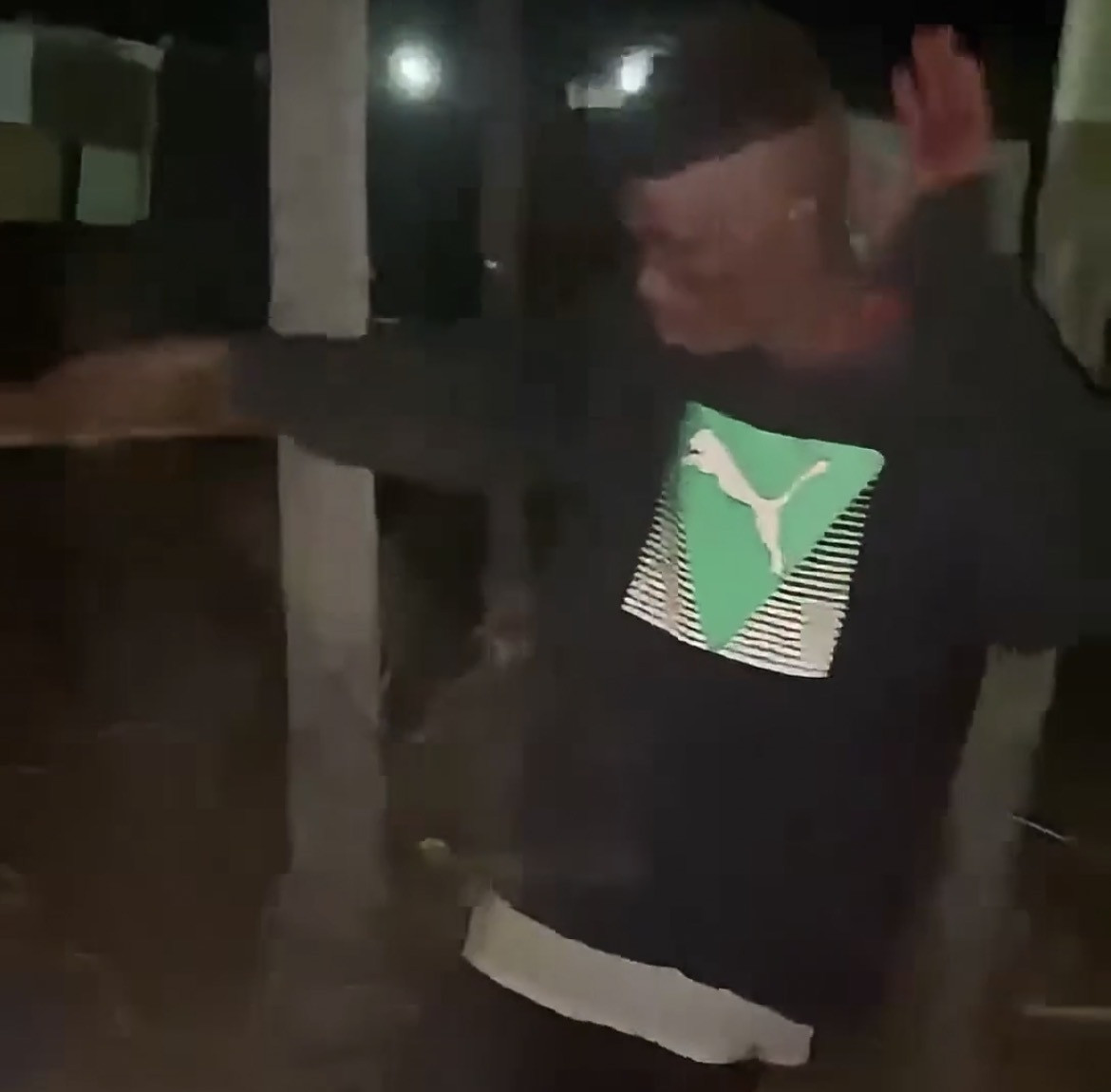
The footage is roughly one minute long. It was filmed after dark in a residential area with unpaved ground, litter, a wooden electricity pole, a low brick structure, and overhead conductors. A man wearing a dark top with a green logo is seen among a group of people. He is later shown climbing the pole and standing on the brick structure while another person points at the wires. People off-camera can be heard giving instructions. The clip is being shared with captions stating that a copper cable thief was cornered and forced to restore power with his bare hands.
No official statement from the South African Police Service, Eskom, or a municipality has identified the suburb, the date the incident occurred, the identity of the man, or whether a case was opened. The exact location is therefore unconfirmed. One social-media comment speculated Bloemfontein; that has not been verified.
What the clip does show is a community response of a type that has been recorded in South African townships for years when residents catch people they believe are responsible for cutting supply cables. Cable theft, locally often called izinyoka, repeatedly leaves streets without electricity. Repair crews cannot always reach sites immediately. Households then sit in the dark for hours or days. That is the background against which crowds form when a suspect is found near poles or trenches.
Assault and forcing a person to climb live or recently cut infrastructure are criminal acts. South African law treats assault as a crime regardless of the alleged offence that triggered the confrontation. Police have in previous similar incidents used teargas or made arrests when crowds turned violent, and they have also rescued suspects from beatings. Tampering with essential infrastructure is itself a serious statutory offence. Courts have imposed direct imprisonment of ten years, fifteen years and sixteen years in recent copper-cable cases after convictions for cutting Eskom or municipal conductors.
The national scale of the problem is documented in official and municipal figures. Eskom reported 505 arrests for crimes against its infrastructure in the year to March 2026. It said crime-related incidents fell 13 percent and estimated losses dropped to R191 million, with recoveries of R34 million. City Power in Johannesburg recorded 652 cable-theft and vandalism incidents between July 2025 and January 2026, after 481 incidents in the first half of 2025. In the second quarter of the 2025/26 financial year it reported 62 arrests for theft and vandalism-related offences. The City of Cape Town said that between July 2025 and April 2026 its Metal Theft Unit made 88 arrests, recovered more than a kilometre of stolen cable and more than 800 kilograms of metals, conducted 5 979 hotspot patrols and 1 257 scrapyard inspections, issued 3 095 fines and closed 42 large scrap operations and 94 smaller dealers. In March 2026 the same metro said it had spent R44.5 million repairing vandalised and stolen electricity infrastructure.
Thefts also kill. City Power has recorded two dozen electrocution deaths over a two-year period among people tampering with its network to steal parts or make illegal connections. Separate incidents in 2025 and 2026 produced fatal or severe burns in Cullinan, Eldorado Park, Bloemfontein’s Bayswater area, Isipingo, Roodepoort and other sites when suspects cut live high-voltage cables or entered mini-substations. Many of those deaths were discovered only when crews arrived to restore supply after an outage.
Copper remains valuable on the scrap market. Stolen lengths are cut, stripped and sold through dealers, some of which have been closed after failing to record the source of metal. Recent operations have also recovered tonnes of cable from vehicles and informal settlements. In one September 2026 case police seized an estimated 1.8 tonnes of copper and arrested three suspects after an alleged bribe offer. In another, six men were arrested at a national key point in Plattekloof after being found with bags of copper; the stolen metal was valued at R110 000 and fence damage at R60 000.
The circulating video does not show whether the man completed a reconnection, whether the lines were live, whether he was injured, or whether police arrived. Working on overhead conductors without isolation, personal protective equipment or a work order is dangerous even for trained technicians. Communities that force a suspect onto a pole expose both that person and bystanders to electrocution and fire risk.
No arrest linked specifically to this clip has been announced. No hospital report has been published. Until a police station or the relevant electricity distributor confirms the facts, the only verified public record is the footage itself and the wider, documented pattern of cable theft, outages, electrocutions and community confrontations that produced it.
OTHER NEWS
73-year-old woman beaten to death in Bredasdorp home while husband worked in garden
BREDASDORP – A 73-year-old woman was beaten to death inside her home on Republic Street in Bredasdorp on Monday, 21 September 2026. Police have opened a murder and house robbery case. No arrests have been made.
The victim has been identified as Mariette Mouton. She was found inside the house after her 81-year-old husband, who had been working in the garden at the back of the property, went looking for her.
Police spokesperson Captain FC van Wyk confirmed that Mouton was already deceased when officers arrived. He said she was struck with a blunt object.
Van Wyk said access to the house was gained through a back door that was found unlocked. The husband had been gardening at the rear of the property at the time. He later entered the house, found his wife, and summoned help.
Items were taken from the residence. These included electronic devices, jewellery, a kitchen knife and garden tools.
Bredasdorp police registered both a murder docket and a house robbery docket. The investigation is ongoing. The motive has not been confirmed and the full circumstances of the attack remain under investigation.
Investigators are examining available CCTV footage from the area in an effort to establish a timeline and identify a suspect or suspects. Police said they are following every possible lead.
Cape Agulhas Mayor Raymond Ross said police had briefed him on the progress of the case. He said investigators were following every possible lead.
No suspect has been named and nobody has been arrested.
Police have appealed to anyone who saw anything or who has information that could assist the investigation to contact their nearest police station or Crime Stop on 08600 10111.
Bredasdorp is a small coastal town in the Overberg region of the Western Cape, in the Cape Agulhas municipal area. The house is on Republic Street.
The attack took place while the victim was inside the home and her husband was outside at the back of the property. Police have not released a precise time for the incident.
Forensic work and the review of surveillance footage form part of the current investigation. Stolen property is also being traced.
Anyone with information can report it at a police station or anonymously on Crime Stop 08600 10111.