Cameron Waldeck-Cooks Case: Family Questions Police After Teenagers’ Phones Were Returned Without Data Download
13 min read

Welcome back! Log in to keep reading without ads.

The family of 17-year-old Cameron Waldeck-Cooks has raised serious concerns about the handling of evidence in the investigation into her death after allegedly discovering that police returned her cellphone and that of 19-year-old Ethan Coetzee without first downloading their data for forensic analysis.
Cameron and Ethan were found dead at a holiday property near Sabie, Mpumalanga, on 3 August 2026. Police initially opened inquest dockets before launching a murder investigation into Cameron’s death following preliminary post-mortem findings that suggested she may have been strangled.
More than two months later, Cameron’s family says important questions remain unanswered, including whether investigators secured the teenagers’ digital evidence, examined surveillance footage and properly investigated the circumstances surrounding their deaths.
The family has requested a public inquest and is seeking further clarity from the authorities about the progress of the investigation.
Cellphones allegedly returned on day bodies were discovered
One of the family’s main concerns relates to the handling of the teenagers’ cellphones at the scene.
According to information contained in correspondence from the family’s attorneys, Cameron’s cellphone was handed to her parents, while Ethan’s device was returned to his parents.
The family questioned why the devices were allegedly released without first being secured for forensic examination and having their data downloaded.
In a letter reportedly sent to the investigating officer and prosecutors on 17 September, the family’s attorneys raised concerns about whether the cellphones had been collected and examined as potential evidence in the murder investigation and related inquest proceedings.
The attorneys questioned whether the information stored on the devices could have assisted investigators in establishing the circumstances surrounding the deaths.
Cellphones can contain messages, call logs, photographs and other digital information that may help investigators reconstruct events before a death. Depending on the available data, forensic analysis may also help establish communication patterns and timelines relevant to an investigation.
The family has reportedly kept Cameron’s cellphone secure since receiving it to avoid questions about whether the device had been tampered with.
It remains unclear from the publicly available information whether police subsequently conducted a forensic examination of both devices or whether any extracted data has been included in the investigation docket.
Material found on Cameron’s phone raises gender-based violence concerns
Cameron’s family has also raised concerns about material reportedly discovered on her cellphone after it was returned.
The family’s attorney described the material as extremely disturbing and said it provided additional context about the relationship between Cameron and Ethan.
According to the attorney, the material supported the family’s concerns about possible gender-based violence in the relationship.
The full contents of the material have not been publicly disclosed, and the allegations have not been tested in court.
The family believes the information may be relevant to understanding what happened before Cameron’s death and has questioned whether investigators adequately examined the relationship as part of their inquiry.
Earlier reports also contained allegations of controlling behaviour and monitoring of Cameron’s online activity during the relationship. These claims have not been established as facts in court, and Ethan’s family has disputed characterisations of his behaviour.
The cellphone material and the allegations surrounding the relationship remain matters requiring proper investigation. They do not, on their own, establish who was responsible for Cameron’s death.
Retired Hawks colonel questions police evidence handling
Retired Hawks colonel Tollie Vreugdenburg has reportedly questioned why the cellphones were not seized at the scene and submitted for forensic analysis.
Vreugdenburg said the devices should have been secured, documented and sent for examination by digital forensic specialists.
Such an examination could help investigators determine whether communications or other information stored on the phones could clarify the events leading up to the deaths.
The fact that the devices were allegedly returned before a forensic download also raises questions about the handling and preservation of potential evidence.
When digital evidence is collected, investigators generally need to document its handling and preserve its integrity so that any information subsequently relied upon can be assessed for authenticity.
However, the return of a cellphone does not automatically make its data unusable. A forensic examination may still be possible, although investigators may need to address questions about the device’s handling and whether its contents changed after it left police custody.
Vreugdenburg reportedly indicated that the information could still be retrieved and examined, while acknowledging that the circumstances surrounding the devices’ handling could raise questions about the chain of evidence.
Whether either phone has since undergone a forensic examination has not been clearly established in the public reporting.
Family questions whether CCTV and Wi-Fi records were secured
The cellphones are not the only potential sources of evidence raised by Cameron’s family.
The family’s attorneys also questioned whether investigators secured CCTV footage from the accommodation where the teenagers were found and preserved relevant information from the property’s Wi-Fi router.
The attorneys reportedly sought clarity on whether these records had been obtained and examined as part of the investigation.
Surveillance footage, where available, could assist investigators in establishing movements at the property and identifying people entering or leaving relevant areas.
Wi-Fi router records may also provide information about devices connected to a network, depending on what data was retained and the capabilities of the equipment. Such records would need to be assessed alongside other evidence and would not necessarily establish what a person was doing or who was using a particular device.
The family wants investigators to clarify what evidence was collected, what examinations were conducted and whether all relevant material has been included in the case docket.
It has not been publicly established that CCTV footage or Wi-Fi records were destroyed, lost or deliberately overlooked. The concern raised by the family is whether these potential sources of evidence were properly secured and examined.
Police opened murder investigation after preliminary post-mortem findings
Cameron and Ethan were found dead at a holiday property near Sabie on the morning of 3 August.
Police initially opened inquest dockets while awaiting post-mortem examinations and further forensic information.
On 7 August, Mpumalanga police spokesperson Colonel Mavela Masondo confirmed that preliminary post-mortem findings had prompted investigators to open a murder case relating to Cameron’s death.
According to the preliminary findings communicated by police, Cameron may have died from strangulation, while Ethan may have died by suicide.
Cameron’s parents, Derrick Cooks and Claire Waldeck-Cooks, also appointed an independent forensic pathologist. The family subsequently said the independent pathologist’s preliminary findings were consistent with strangulation and suffocation.
These findings led to the murder investigation, but they do not independently establish who caused Cameron’s death or whether another person will ultimately face criminal charges.
The circumstances surrounding both deaths remain subject to the relevant investigative and judicial processes.
Family says communication from investigators has been limited
Cameron’s family has also expressed frustration about the information it has received since the deaths.
Through their attorneys, the family reportedly raised concerns about limited communication with the investigating team and the lack of clarity about the progress of the case.
The attorneys sought a meeting with the relevant investigators to discuss the evidence and ensure that the family’s concerns were addressed.
According to the reported correspondence, the investigating officer proposed a meeting on 2 October, but the family’s attorneys said subsequent communication had stalled.
The family wants answers about the steps taken by investigators, including whether digital evidence has been examined and whether the available forensic findings have been incorporated into the case docket.
Police have said the investigation remains ongoing and that further disclosure could compromise the inquiry. The authorities have not publicly resolved all the specific concerns raised about the cellphones and other potential evidence.
Family requests a public inquest
Cameron’s family has called for a public inquest at which evidence can be presented and considered by a presiding magistrate.
An inquest examines the circumstances surrounding an unnatural death, including its cause and likely date, and whether an act or omission may have contributed to the death in circumstances involving a possible criminal offence.
The family believes a public process could help establish what happened and provide greater scrutiny of the evidence gathered during the investigation.
Such proceedings would not automatically result in a criminal conviction. However, the findings could assist the relevant authorities in determining whether further action is warranted.
The family is seeking assurance that all relevant evidence has been preserved, properly examined and made available to the judicial process.
Ethan Coetzee’s family calls for restraint
Ethan, 19, was a former pupil of St Stithians Boys’ College, where he matriculated in 2025. Cameron was a Grade 11 pupil at St Stithians Girls’ College.
The Coetzee family has indicated that it would not comment in detail while the investigation and inquest processes remain pending.
In its reported response, the family said it would be inappropriate for the parties involved to discuss matters that could form part of the proceedings.
Regarding electronic devices, the family emphasised that information extracted from a phone would depend on a lawful process being followed to protect the integrity of the data.
The family also said it was observing the grieving process and appreciated being given space to do so.
The position reflects the sensitivity of a case in which both young people have died and the circumstances have yet to be fully established.
Who was Cameron Waldeck-Cooks?
Cameron was a pupil at St Stithians Girls’ College in Johannesburg and had been part of the school community since Grade R.
She was involved in rowing and netball and was remembered by her school as a committed sportswoman who supported and encouraged younger pupils.
Cameron had travelled to the Sabie area for a hiking trip connected to her efforts to achieve the gold level of The President’s Award for Youth Empowerment.
Her death prompted an outpouring of condolences from her school community, friends and sporting circles.
Ethan had completed his schooling at St Stithians Boys’ College in 2025 and was remembered by the school for his involvement in rugby and other sporting activities.
Their deaths have since become the subject of an investigation involving preliminary forensic findings, questions about the handling of potential evidence and requests from Cameron’s family for further scrutiny.
Investigation remains ongoing
The central issue now is whether investigators have secured and examined all the evidence needed to establish the circumstances surrounding Cameron’s death.
The family has questioned the return of the cellphones without an initial forensic download, raised concerns about the possible availability of CCTV and Wi-Fi records, and requested a public inquest.
The allegations about the handling of evidence remain disputed or unresolved, and the contents of the cellphone material have not been fully disclosed publicly.
Police have not publicly established who was responsible for Cameron’s death, and the preliminary findings concerning Ethan’s death should not be treated as a final determination of all the circumstances.
As the investigation continues, Cameron’s family is seeking answers about the evidence, the decisions made at the scene and whether every relevant line of inquiry has been followed.
More than two months after the teenagers were found dead, the family says fundamental questions remain unanswered. The next steps in the investigation and the proposed inquest process may be important in determining what happened at the Sabie property on 3 August 2026.
OTHER NEWS
17-Year-Old Arrested for Double Murder in Cape Town, Second Suspect Arrested With Gun
A 17-year-old boy has been arrested in connection with a double murder in Cape Town following a tracing operation by Anti-Gang Unit detectives.
The teenager was arrested on Sunday, 18 October 2026, at Vygieskraal informal settlement in Athlone. He is accused of involvement in a fatal shooting that took place along Lower Klipfontein Road on 24 August 2026.
According to police, the suspect faces two counts of murder and is expected to appear before the Athlone Magistrates’ Court on Monday, 19 October 2026.
The arrest follows investigative efforts by detectives to trace the suspect in connection with the August shooting. Police have not disclosed further details about the identities of the two victims or the circumstances surrounding the incident.
In a separate incident in the same informal settlement, police arrested another man after discovering a firearm and ammunition during foot patrols.
Officers conducting patrols in Vygieskraal reportedly noticed a man behaving suspiciously and proceeded to search him. The search led to the discovery of a 9mm pistol and 15 rounds of ammunition.
The man was arrested and faces charges of possessing an unlicensed firearm and illegally possessing ammunition. He was also expected to appear before the Athlone Magistrates’ Court on Monday, 19 October.
The two arrests involved separate investigations and different alleged offences. Police have not indicated that the firearm recovered during the foot patrol is linked to the double murder investigation.
The arrests form part of police efforts to trace wanted suspects and remove illegal firearms and ammunition from communities.
The 17-year-old remains a murder suspect, and the allegations against him will be dealt with through the criminal justice system.
OTHER NEWS
Bloemfontein Man Arrested After Police Find M26 Hand Grenade and Imitation Firearm
A 28-year-old man is expected to appear in court after police discovered a used M26 hand-practice grenade and an imitation firearm during an intelligence-driven operation in Bloemfontein.
The suspect was arrested on Saturday, 17 October 2026, after members of the South African Police Service (SAPS) followed up information about a person allegedly in possession of an illegal firearm.
According to the police, three members of the Public Order Policing (POP) Unit and a sergeant from the Diving Unit were involved in the operation. The officers proceeded to identified premises, where they found an informal structure behind the main house and encountered the suspect.
During a search, police discovered a black imitation firearm bearing the description “GLOCK C15”. The item did not have a magazine or trigger.
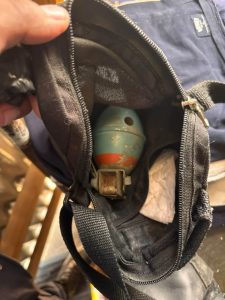
Officers also found a used hand grenade inside a bag. The discovery prompted police to call in the SAPS Bomb and Explosives Unit and the Local Criminal Record Centre (LCRC) to examine the items.
The Bomb and Explosives Unit identified the device as an M26 hand-practice grenade that had already been used. Police reported that it did not contain a detonator or safety lever, and no visible lot number was present.
The grenade’s discovery raised concerns about how the device came into the suspect’s possession. Police stated that possession of this type of grenade is restricted to authorised members of the SAPS and the South African National Defence Force (SANDF), subject to the necessary permission.
Given these restrictions and the circumstances in which the grenade was found, it was suspected to be stolen property.
The 28-year-old was subsequently arrested and detained on a charge of possession of suspected stolen property. Both the imitation firearm and the grenade were seized and booked in as exhibits for further investigation.
The suspect is expected to appear in court soon. Investigations are continuing to establish the circumstances surrounding the possession of the items.
Police have not indicated that the imitation firearm was used in a crime, and the reported discovery of the grenade does not, by itself, establish that the suspect was involved in any other offence.
- Cameron Waldeck-Cooks Case: Family Questions Police After Teenagers’ Phones Were Returned Without Data Download

- Eshowe Triple Murder Suspect Remains on the Run as Police Report No New Developments

- 17-Year-Old Arrested for Double Murder in Cape Town, Second Suspect Arrested With Gun

- Bloemfontein Man Arrested After Police Find M26 Hand Grenade and Imitation Firearm
- Foreign National Arrested in Ballito With Drugs Worth More Than R1 Million