Johannesburg, 2 February 2026 – Emergency services responded to a serious incident in Doornfontein this morning when a transformer explosion led to the partial collapse of a structure at a student accommodation building.
The incident occurred in the New Doornfontein area, near the Johannesburg CBD, at a location on Lower Railway Road at the corner of Staib Street. Emergency calls were received shortly before 6:00 AM, reporting a fire at a substation or small utility storage room attached to the building.
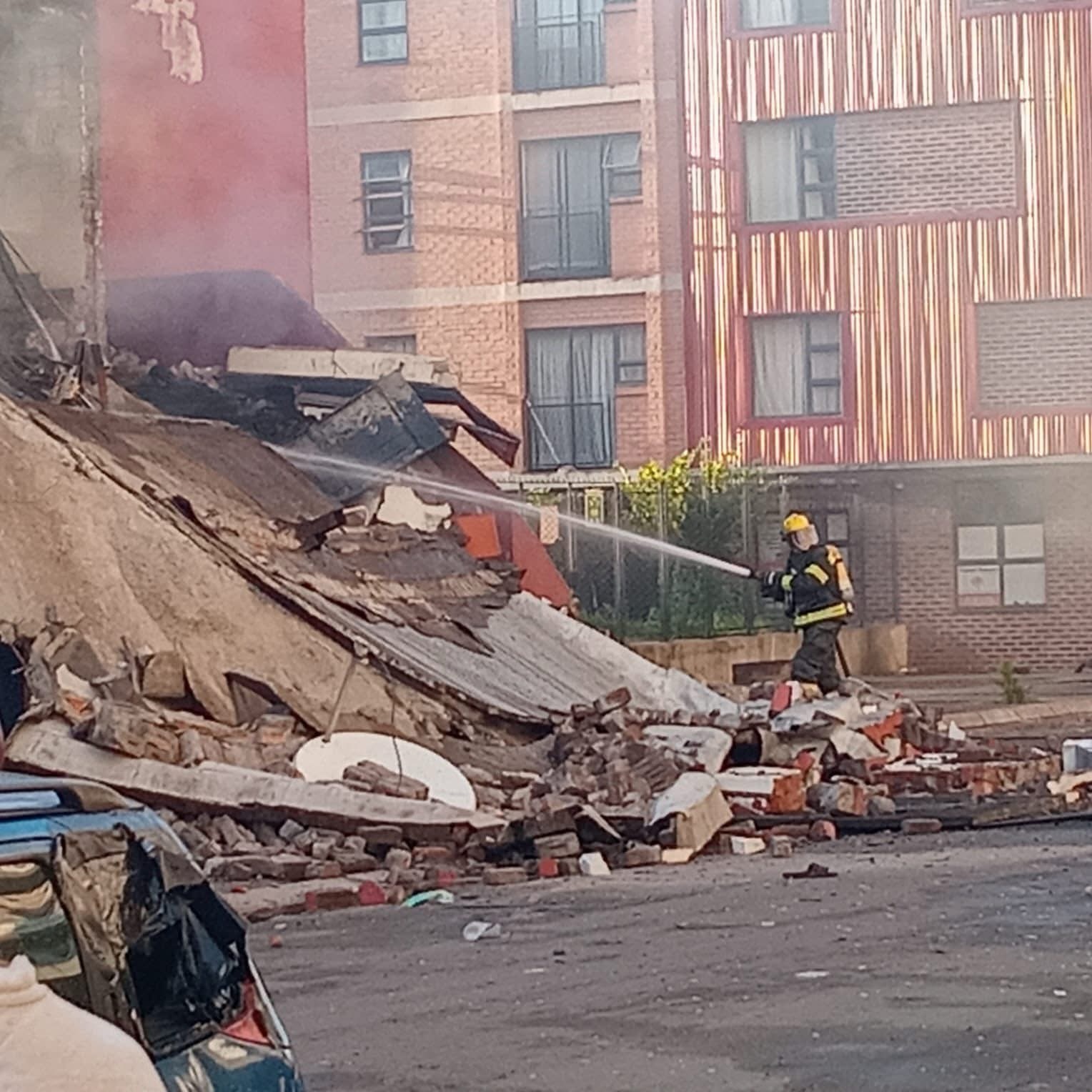
Upon arrival, responders found the utility room on fire. An explosion followed, resulting in the collapse of the room itself and an adjoining boundary wall. Parts of the student residence building were affected, though reports describe it as a partial collapse rather than a full structural failure.
Gauteng Provincial Government Emergency Medical Services (EMS) confirmed that four people were injured in the incident. The injured include one student and three security guards, all of whom sustained third-degree burns. They were transported to nearby hospitals for treatment. No fatalities have been reported, and all nearby residents and occupants have been accounted for, with no indications of anyone trapped under the debris.
City of Johannesburg EMS spokesperson Xolile Khumalo stated that the fire was electrical in origin, involving a transformer housed in the small utility storage room. The matter has been handed over to City Power for further investigation into the exact cause. While initial social media reports and some early accounts suggested a gas explosion or generator involvement, EMS clarified that the incident was electrical and not related to gas.
Public Safety MMC Mgcini Tshwaku was on the scene, and officials noted the need to investigate possible contributing factors, including any structural or infrastructure issues.
Emergency teams, including fire and rescue personnel, remained on site throughout the day. Almost 12 hours after the incident, Joburg Emergency Services continued structural assessments to determine stability and clear rubble safely. Technical teams were required to evaluate damage before allowing further debris removal or entry. Checks were also conducted for any secondary hazards, such as potential gas leaks or additional structural weaknesses.
Students from adjacent buildings gathered nearby during the operation, and authorities were assessing whether residents could safely remain in place overnight or if alternative accommodations would be needed.
The incident caused local disruption, with emergency vehicles on scene and some cordoning in the area. City Power is handling the transformer-related aspects, and investigations are ongoing to establish the precise trigger of the fire and explosion.
No further injuries or complications have been reported as of late afternoon, and emergency services continue to monitor the site for safety. Updates are expected as the investigation progresses.
Watch: Man Attacked by Crocodile While Trying to Swim Across Limpopo River.
The Limpopo River, forming a natural border between South Africa, Zimbabwe, Botswana, and Mozambique, poses severe dangers to anyone attempting to cross its waters. The most significant threat is the presence of Nile crocodiles (Crocodylus niloticus), large and aggressive predators that inhabit the river and its tributaries.
Nile crocodiles are among the most dangerous large predators in Africa and are responsible for hundreds of human deaths annually across the continent. Estimates indicate between 275 and 745 attacks each year by this species, with approximately 63% proving fatal. Many incidents go unreported due to remote locations, limited record-keeping, and underreporting in affected regions.
These crocodiles can grow to lengths of 4–5.5 metres and are ambush predators that target prey near or in water. They commonly attack humans engaged in activities such as bathing, swimming, fishing, or crossing rivers. In southern Africa, including areas along the Limpopo, such encounters frequently occur in natural water bodies like rivers and streams.
Historical records from South Africa and Eswatini document 214 Nile crocodile attacks between 1949 and 2016, with 185 of these occurring in South Africa alone. Attacks have been recorded in provinces including Limpopo, where the river flows. Most incidents involve victims entering the water, and fatal outcomes are common when larger crocodiles are involved.
The Limpopo River has been the site of documented fatalities. In March 2006, a 68-year-old visitor was killed on the river when a crocodile emerged and pulled him underwater during a wildlife tour.
Illegal border crossings between Zimbabwe and South Africa increase the risk. Desperate individuals attempt to wade or swim across to seek economic opportunities, fleeing high inflation, unemployment, and poverty. The river’s fast currents, seasonal flooding, and hidden depths already cause drownings, but the presence of Nile crocodiles turns these crossings into life-threatening endeavours. Reports describe survivors and fatalities alike, with crocodiles posing a constant predatory hazard in the infested waters.
Flooding worsens the danger. Heavy rains cause the Limpopo and other rivers to overflow, displacing crocodiles into new areas, including towns and unexpected waterways. In early 2026, widespread flooding in southern Mozambique, where the Limpopo also flows, led to at least three confirmed crocodile-related deaths amid rising river levels and submerged communities.
Authorities in South Africa and neighbouring countries have repeatedly warned residents and travellers against entering the Limpopo River or attempting crossings outside official border posts. The combination of strong currents, deep sections, and a healthy population of Nile crocodiles makes the river one of the most hazardous natural barriers in the region.
Crossing the Limpopo without authorisation or proper precautions remains extremely dangerous. Official border facilities exist to allow safe passage, and any alternative route exposes individuals to drowning, crocodile attacks, and other life-threatening hazards.