KuGompo City, Eastern Cape – Monday, 30 March 2026
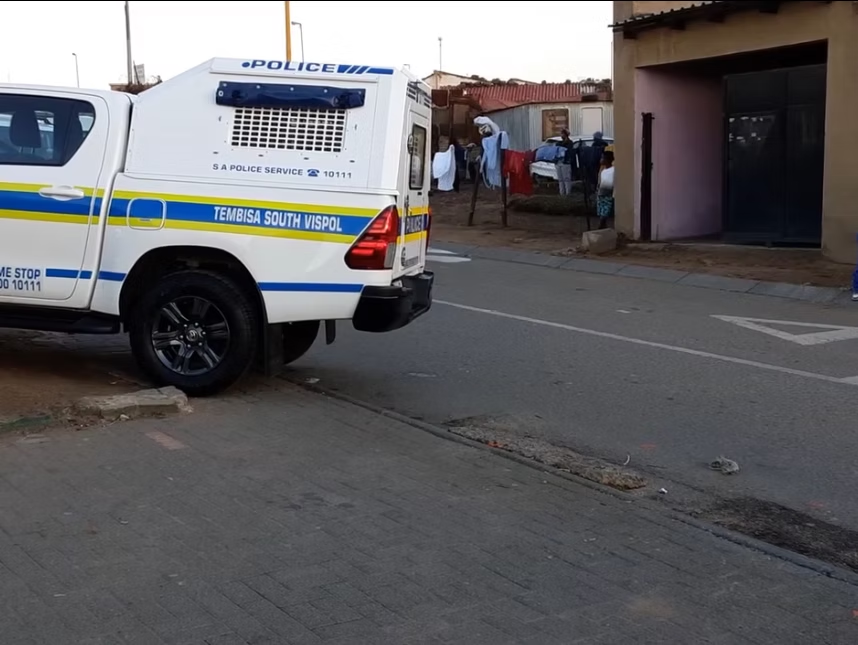
Violence broke out in KuGompo City (formerly East London) in the Eastern Cape on Monday when a protest against the reported coronation of a Nigerian national as “Igwe Ndigbo Na East London” escalated into unrest.
The demonstration was organised by the March and March movement, along with other civic groups, traditional leaders, and political parties including ActionSA. It followed the circulation of videos and photographs on social media earlier in March 2026 showing the crowning of Chief Solomon Ogbonna Eziko as “Igwe Ndigbo” in the area.
The Eastern Cape Department of Cooperative Governance and Traditional Affairs (COGTA) rejected the alleged inauguration, stating that it did not follow constitutional processes or local traditional protocols. The department and the provincial House of Traditional and Khoisan Leaders distanced themselves from the event, describing it as irregular and illegitimate. Traditional leaders, including those from the amaRharhabe Kingdom, also condemned the ceremony as disrespectful to established customary authority.
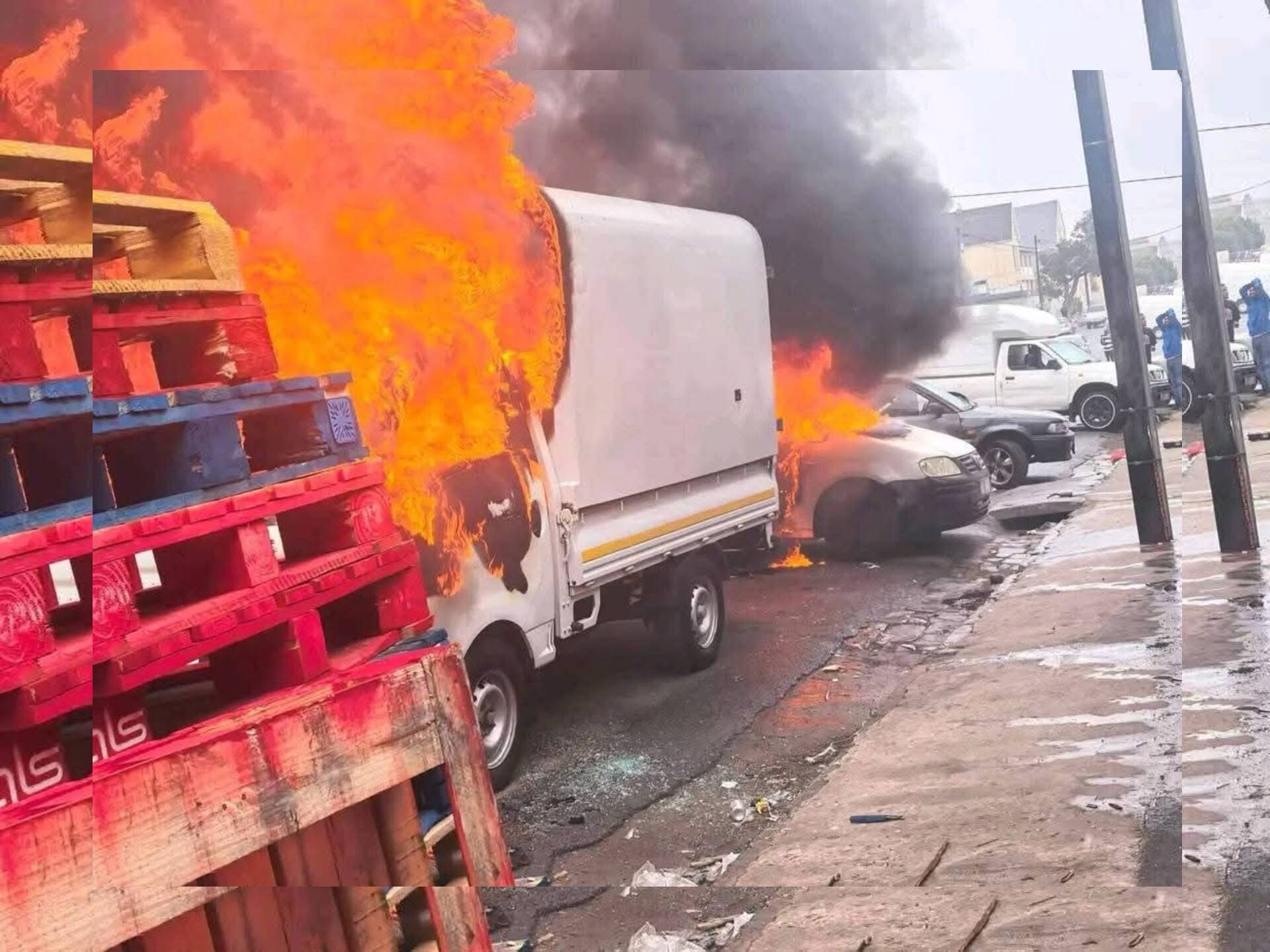
The protest began peacefully but brought traffic to a standstill in parts of KuGompo City. It later turned volatile, with reports of clashes between demonstrators and authorities. Protesters set vehicles alight, including panel vans, bakkies, and trucks. Eastern Cape police confirmed that 12 cars were damaged during the unrest. Other accounts indicated that at least 13 vehicles were set on fire, while some reports mentioned up to 15 vehicles burnt and a higher number damaged.
Video footage from the scene showed vehicles burning and crowds confronting police. Police deployed stun grenades and rubber bullets to disperse the demonstrators. Several buildings, some allegedly belonging to foreign nationals, were also torched or vandalised. Shops in the area reportedly closed as tensions rose.
One person was stabbed and hospitalised during the events. Confrontations involving different groups, including reports of attacks on protesters by individuals in a vehicle, were also noted.
The March and March movement, led by Jacinta Ngobese-Zuma, participated in the KuGompo protest as part of its ongoing campaigns on immigration and citizen prioritisation. The group has held similar demonstrations in other provinces, including a recent large gathering in Durban.
Authorities worked to restore order in the affected areas. Protesters later regrouped at City Hall, where they were expected to submit a memorandum.
As of Monday evening, full details on the exact number of arrests, total injuries, or comprehensive damage assessments had not been released by police. Investigations into the incidents were ongoing.
The unrest occurred on the same day as separate marches in the Eastern Cape linked to Human Rights Day observances by the ANC and allies, though those events were not connected to the KuGompo protest.
This report is compiled from official statements, police confirmations, and multiple eyewitness and media accounts of the events on 30 March 2026. Further updates are expected as more information becomes available.
Fatal Crash on M7 Durban-Bound Before Bellville Offramp Leaves One Dead
Durban – One person has been killed and at least one other injured in a crash on the M7 highway in the Durban-bound direction before the Bellville offramp on Monday, 30 March 2026.
The incident, which occurred in the Malvern area west of Durban, involved two trucks. Emergency services, including private EMS and ALS Paramedics, responded to the scene where one individual was declared deceased on arrival. Paramedics are attending to additional patients who sustained injuries.
Authorities have closed the Durban-bound lanes of the M7 to allow emergency teams to work safely and clear the roadway. Motorists are strongly advised to avoid the area and use alternative routes, as significant delays and traffic disruptions are expected in the vicinity.
ALS Paramedics spokesperson Garrith Jamieson confirmed the fatality and ongoing medical response, urging drivers to steer clear of the affected section of the highway.
No further details regarding the exact cause of the collision or the identities of those involved have been released at this stage. Investigations by traffic authorities are underway.
Motorists travelling in the greater Durban and Bellville areas are encouraged to plan their routes in advance, remain patient during the disruption, and stay updated through official traffic channels. Safety on the roads remains a priority as recovery operations continue.
This is a developing story, and more information may become available as the situation unfolds.
Three Injured in Vehicle Crash on Malandela Road in KwaMashu
KwaMashu, KwaZulu-Natal – A serious motor vehicle collision occurred on Malandela Road in KwaMashu on Sunday, 29 March 2026, leaving three people injured.
According to initial reports, a vehicle lost control while travelling along the road. It veered off the roadway and collided with two stationary vehicles before coming to a rest against a nearby residential property.
The three injured individuals sustained injuries ranging from minor to moderate. Paramedics from KZN VIP Emergency Medical Services, along with other emergency responders, were dispatched to the scene following multiple reports of the incident. Upon arrival, they conducted a rapid triage, assessed and treated the patients on site, stabilised them, and transported all three to nearby medical facilities for further care.
Occupants of the affected residential property were not injured in the collision, and no significant structural damage to the property was reported. Emergency services managed the scene to ensure the safety of all involved.
At this stage, the exact cause of the loss of control remains unknown. No further details have been released regarding the types of vehicles involved, possible contributing factors such as speed, weather conditions, or mechanical issues. Authorities are expected to conduct a full investigation into the incident as part of standard road traffic procedures.
This collision highlights the risks associated with driving on suburban roads where vehicles may be parked and residential properties are in close proximity. Motorists in the area and across KwaZulu-Natal are reminded to maintain vehicle control, observe speed limits, and remain alert to prevent similar incidents, especially during periods of high road usage.
No fatalities were reported, and all injured parties received prompt medical attention. Updates on the investigation or the condition of those hospitalised will be provided as more information becomes available.
- Phone Theft and Pickpocketing Remain a Major Challenge in South Africa
- Chaos Erupts in KuGompo City as Protest Against Alleged Nigerian ‘King’ Coronation Turns Violent
- Fatal Crash on M7 Durban-Bound Before Bellville Offramp Leaves One Dead
- Three Injured in Vehicle Crash on Malandela Road in KwaMashu
- Safety Alert Issued for Lebombo Border Route in Mpumalanga as Reports of Violent Crime Escalate
Knowing the Rules of the Road: Why South African Pedestrians Must Prioritise Safety
In South Africa, pedestrians remain one of the most vulnerable groups on our roads. Recent statistics from the Road Traffic Management Corporation (RTMC) show that pedestrians account for around 45-47% of all road fatalities in many reporting periods, with figures often hovering near 41% during festive seasons. In the 2025/26 festive period, collisions involving pedestrians featured prominently among the leading causes of crashes and deaths, particularly in major urban centres like Johannesburg, Cape Town, eThekwini, and Tshwane. Young adults aged 25-44 are disproportionately affected, and many incidents occur due to jaywalking, poor visibility at night, alcohol impairment, or simply failing to cross safely.1
These numbers are not just statistics — they represent families, workers, and community members lost while walking to taxis, schools, shops, or home. The good news is that many of these tragedies are preventable through basic knowledge of road rules and responsible behaviour.
Legal Responsibilities of Pedestrians Under the National Road Traffic Act
South African law, governed by the National Road Traffic Act (NRTA) and its regulations, clearly outlines pedestrian duties:
- Use sidewalks where available: If a pavement or footpath exists next to the road, you must use it. Walking on the roadway is only permitted when crossing or for another valid reason.
- Walk facing traffic on the roadside: Where no sidewalk exists, stay as close as possible to the right-hand edge of the road, facing oncoming vehicles. This allows you to see approaching traffic and react in time.
- Cross only at safe, designated points: You may legally cross a public road at a marked pedestrian crossing (such as a zebra crossing), an intersection, or more than 50 metres away from the nearest crossing or intersection — but only when it is safe to do so. Jaywalking (crossing indiscriminately between crossings) is unsafe and often illegal in controlled areas.
- Never linger or run suddenly: Once you start crossing, proceed briskly without stopping unnecessarily. Do not suddenly enter a crossing if a vehicle is too close to stop safely.
- Obey traffic signals: At signalised crossings, wait for the green pedestrian light (the “little green man”) before crossing. Observe all traffic lights and signals.
- Avoid freeways entirely: Pedestrians are prohibited from walking on freeways or their shoulders. Always use pedestrian bridges where provided.
Drivers have obligations too — they must yield to pedestrians at marked crossings and intersections — but as a pedestrian, you cannot assume every driver will stop. Your safety ultimately depends on your own vigilance.30
Practical Tips for Safe Crossing
Knowing when and where to cross can save your life:
- Stop, look, and think: Before stepping off the kerb, stop at the edge. Look right, left, and right again. Listen for traffic, especially from behind or around obstacles like parked cars or taxis.
- Choose marked crossings: Zebra crossings, traffic-light crossings with pedestrian signals, scholar patrols near schools, and pedestrian bridges are the safest options. At a zebra crossing, make eye contact with drivers if possible, but never assume they will stop — wait until traffic has clearly yielded.
- Cross straight and briskly: Walk directly across the road (not diagonally) to minimise your time in the danger zone. Keep looking and listening while crossing.
- Be extra cautious at bus/taxi stops: Avoid crossing directly in front of or behind stationary vehicles that block your view. Move to a clear section of road.
- Visibility matters: Wear bright or reflective clothing, especially at night or in bad weather. Many fatalities occur after dark when drivers struggle to see pedestrians.
- Avoid distractions and impairment: Put away your phone, remove headphones, and never cross while under the influence of alcohol or drugs. Distracted or impaired pedestrians are far more likely to misjudge speeds and distances.
In rural areas or townships where infrastructure may be limited, these rules become even more critical. Walk facing traffic, use available crossings or intersections, and be patient — rushing across can have fatal consequences.
A Shared Responsibility for Safer Roads
Road safety is not only about enforcement or better infrastructure (though both are urgently needed). It starts with individual responsibility. Pedestrians who know and follow the rules reduce their risk dramatically and help create a culture where drivers expect and respect people on foot.
Parents, teachers, and community leaders play a key role in teaching children these habits early. Simple actions — like modelling “stop, look, listen” — can protect the next generation.
As South Africans, we share the roads. Drivers: slow down in pedestrian-heavy areas, especially at night and near schools or taxi ranks. Pedestrians: respect the rules, stay visible, and cross only when safe.
By understanding and applying these basic rules of the road, we can honour those lost and prevent future tragedies. Your life — and the lives of those waiting for you at home — is worth the extra few seconds it takes to cross safely.
Stay alert. Stay visible. Stay alive.
This article is for educational purposes and draws on official road safety guidelines from the RTMC, Arrive Alive, and the National Road Traffic Act. Always consult the latest regulations or local traffic authorities for specific advice.