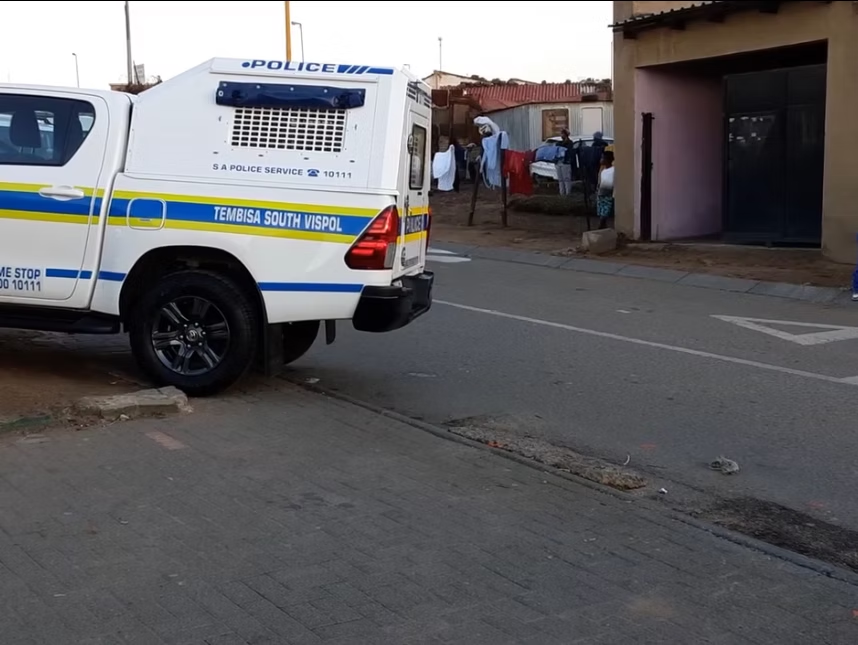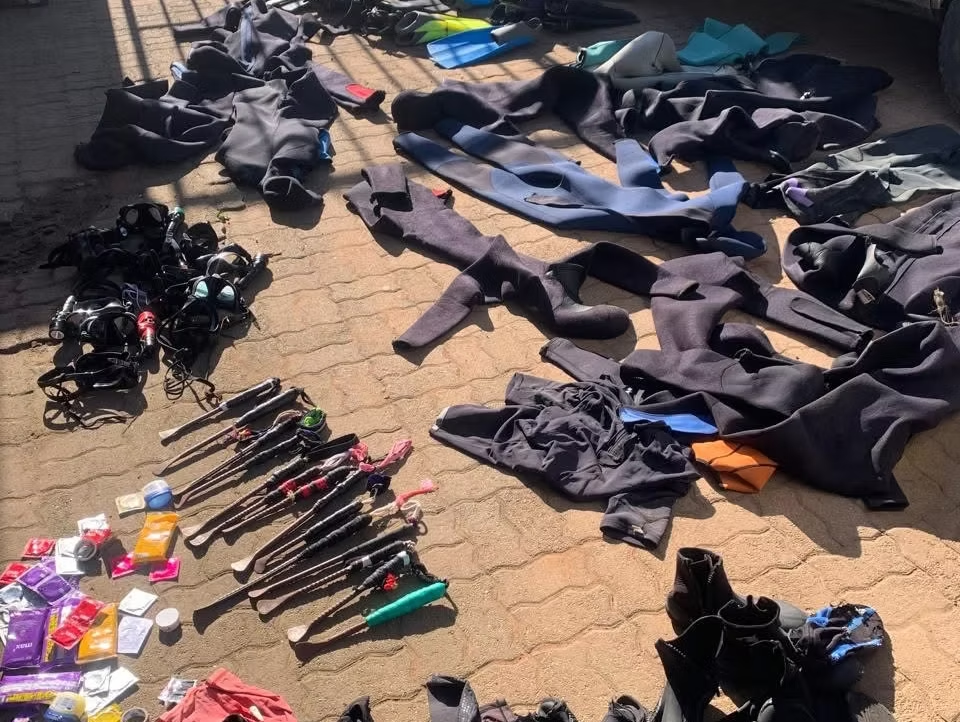
The incident occurred in the Durbanville area, with reports emerging on the same day referencing a bike shop robbery in the suburb. Community discussions and crime alert pages highlighted the event, including comments noting the early opening hours of the shop and the risks faced by business owners in the area.
Details remain limited in public reports as of Tuesday evening. Social media posts and local forums described the matter as a robbery at a bike-related business, with one platform sharing video footage of an incident in Durbanville on the morning of March 31. A separate post referenced a robbery “across from the Traffic Department” in Durbanville on the same morning.
No confirmed information has been released regarding the exact time of the robbery, the number of suspects involved, whether weapons were used, the value or specific items stolen (such as bicycles, parts, or cash), or any injuries to staff or bystanders. Authorities have not issued an official statement detailing the circumstances, and it is unclear if any arrests have been made or if surveillance footage has been publicly circulated beyond community shares.
A related report on a cycling forum noted the theft of a specific Morewood Softail bicycle in Durbanville on March 31, 2026, though it is not explicitly confirmed as connected to the shop robbery.
Local community safety pages and groups have urged vigilance in the Durbanville area following the reports. Residents and business owners have discussed the broader challenges of crime affecting small retailers in the suburb, with some suggesting enhanced security measures for early-morning operations.
The South African Police Service (SAPS) in the Western Cape has not yet provided verifiable public updates on this specific case as of the time of reporting. Investigations into such incidents typically involve gathering witness statements, reviewing available CCTV, and cross-referencing with similar crimes in the northern suburbs of Cape Town.
This event adds to ongoing concerns about property crimes and robberies targeting businesses in Durbanville and surrounding Cape Town areas. Further details are expected as police inquiries progress and any official case numbers or updates are released.
Note: All information above is drawn strictly from publicly available community reports and alerts circulating on March 31, 2026. No unverified speculation or details from unconfirmed sources have been included.
South Africa continues to experience a high proportion of road fatalities involving pedestrians.
Data from the Road Traffic Management Corporation shows that pedestrians accounted for 45% of total road fatalities in 2023, with 5,360 pedestrian deaths recorded that year out of 11,883 total fatalities. In 2025, the country recorded 11,418 road fatalities.
During the 2024/2025 festive season, pedestrians made up 41% of all road fatalities. Preliminary figures for the 2025/2026 festive season, covering 1 December 2025 to 11 January 2026, indicate that pedestrians comprised 44% of the 1,427 total fatalities recorded from 1,172 crashes. Easter 2025 data showed pedestrians accounting for 40.3% of road fatalities.
Quarterly reports have recorded pedestrian proportions ranging from 44.4% to 46.7%. In the fourth quarter of the 2024/2025 financial year, pedestrians represented 46.7% of fatalities.
Urban districts have recorded particularly high numbers of pedestrian fatalities. In the 2025/2026 festive season, the top districts included the City of Cape Town, City of Johannesburg, eThekwini, Nkangala District, and City of Tshwane. Provinces with consistently high pedestrian fatality percentages include Gauteng, KwaZulu-Natal, and the Western Cape.
Pedestrian fatalities occur disproportionately at night and in conditions of reduced visibility. Official reports identify key contributing factors including speeding by motorists, pedestrians crossing outside designated areas, alcohol impairment among both drivers and pedestrians, and inadequate infrastructure such as pavements, crossings, and street lighting.
Crashes involving pedestrians have accounted for more than 30% of fatal crash types in some periods, with “accident with pedestrian” frequently ranking as one of the leading crash types.
The 25 to 44 age group has constituted the largest share of pedestrian fatalities, often exceeding 45% and reaching 48.17% in certain quarterly data and 46.3% during Easter 2025. Children have accounted for approximately 10% to 15% of pedestrian deaths in various reporting periods.
Road safety reports from the Road Traffic Management Corporation and the Department of Transport note that human factors, including driver behaviour and pedestrian actions, remain primary contributors to these incidents. Speed too high for prevailing conditions and jaywalking feature prominently among recorded causes.
These statistics are drawn from annual, festive season, Easter, and quarterly reports compiled by the Road Traffic Management Corporation up to early 2026. Pedestrian deaths continue to represent one of the most significant challenges in national road safety efforts.
Helen Zille Takes a Dip in Johannesburg Pothole to Highlight Infrastructure Failures
Johannesburg – Democratic Alliance Federal Council chairperson and Johannesburg mayoral candidate Helen Zille waded into a large water-filled pothole in the city on Monday, 30 March 2026, to spotlight ongoing infrastructure and service delivery challenges.
The pothole resulted from a burst pipe that had reportedly been repaired previously but failed again. In footage she shared, Zille referred to the moment as her “afternoon swim” and noted the absence of any maintenance plan, observing that the crater continued to expand despite earlier interventions.
Zille, serving as the DA’s candidate for mayor of Johannesburg ahead of the 2026 municipal elections, used the unconventional action to draw public attention to persistent problems including deteriorating roads, recurring water leaks, and broader municipal infrastructure decay.
The footage captured Zille navigating the flooded pothole while commenting on the lack of proper upkeep. In recent weeks, she has documented multiple similar issues across Johannesburg, including burst pipes that waste large volumes of potable water, sinkholes, and sewage spills in areas such as the CBD and suburbs like Melville and Linbro Park.
Her campaign has repeatedly highlighted cases where clean drinking water is lost through leaks while residents experience water shortages and are urged to conserve usage. Zille has walked through affected streets, pointing out clusters of potholes, sinkholes, and leaks as evidence of systemic failures in road and water management.
Zille was announced as the DA’s Johannesburg mayoral candidate in September 2025. Her platform centres on restoring basic services, repairing critical infrastructure, and addressing the impact of unstable coalitions on effective city governance.
The event reflects wider public dissatisfaction with Johannesburg’s road network and water infrastructure. Water-filled potholes caused by burst pipes have become a frequent occurrence in many neighbourhoods, often remaining unaddressed for long periods.
Zille’s action did not include any specific call for immediate personal intervention but focused instead on raising awareness of these recurring municipal shortcomings. She has consistently framed her candidacy around delivering practical fixes to the service delivery crises affecting residents daily.
As Johannesburg approaches the 2026 local government elections, the image of a mayoral candidate swimming in a pothole has brought renewed focus to the scale of infrastructure problems confronting the city’s residents.
- A cycle shop in Durbanville, Cape Town, was targeted in a robbery on Tuesday, March 31, 2026.
- South Africa continues to experience a high proportion of road fatalities involving pedestrians.
- Helen Zille Takes a Dip in Johannesburg Pothole to Highlight Infrastructure Failures
- Former Brits Teacher Receives Life Sentence for Murdering Wife Whose Body Was Found Next to Railway Line
- Foreign National Avoids Drunk Driving Charge at Durban Roadblock Despite Admitting to Drinking and Attempting to Bribe Metro Officer
Foreign National Avoids Drunk Driving Charge at Durban Roadblock Despite Admitting to Drinking and Attempting to Bribe Metro Officer

A foreign national, identified as female in circulating video footage, was stopped during a routine vehicle check point operation conducted by the Durban Metropolitan Police Service in KwaZulu-Natal.
At the roadblock, the woman admitted to having consumed alcohol. She then offered cash to a metro police officer in an apparent attempt to avoid further consequences related to the stop.
The officer immediately rejected the bribe offer and called out the attempt, following standard procedure by reporting it. A senior officer or police boss was involved in the interaction and took time to explain upcoming new laws to the woman.
According to accounts from the video and social media posts, the foreign national was not arrested and escaped a drunk driving charge. She was also not charged for the attempted bribery.
Under South African law, offering a bribe to a public official constitutes a criminal offence in terms of the Prevention and Combating of Corrupt Activities Act. Both offering and accepting a bribe are treated as serious offences, with officers required to document such attempts and proceed with formal charges where applicable.
No official statement from the Durban Metro Police Service has been released confirming details of the incident, including the exact date, the precise amount of cash offered, the woman’s nationality or identity, any breathalyser or blood alcohol test results, or reasons why no arrest or charges were pursued for either suspected drunk driving or bribery.
Circulating video footage of the interaction has been shared widely on social media platforms, often with disclaimers noting that the images and video are not owned by the accounts posting them and are used for educational and awareness purposes only.
The incident occurred amid broader roadblock operations in the Durban area and KwaZulu-Natal, where metro police, Road Traffic Inspectorate, and other agencies conduct enforcement actions targeting drunk driving and other traffic offences. In this specific case, the woman was allowed to proceed without arrest or charges following the rejected bribe attempt and the explanatory discussion.
No further confirmed details on any subsequent investigation, court proceedings, or official follow-up were available in public sources at the time of reporting.